11 November 2026·6 min readGUIDES
How to choose a domain extension (without overpaying every year)
Short term or long term? Which domain ending fits you, what each one costs to keep, and where to buy it without overpaying.
Before picking a name or a website to buy from, ask yourself one question: how long will I keep this domain?
You never really buy a domain. You rent it, one year at a time. The first year is often very cheap, sometimes almost free, because companies use it to win you over. From the second year on, you pay the normal price, called the renewal price, and it can be two or three times higher.
- Short term (a hackathon, a test idea, a dumb website ,an event site you will drop after a year): grab whatever has the best first-year deal. The renewal price doesn't matter, because you won't renew.
- Long term (your business, portfolio, personal brand or anything you will share widely): ignore the first-year deal and look only at the renewal price. That is what you will pay every year after.
Most of this post is about the long term, because that is where people lose money without noticing.
Two kinds of domain endings
The part after the dot is called the extension. There are two families.
Generic endings like .com, .net, .org, .xyz, .dev and .app don't belong to any country. Anyone anywhere can buy them. .com is the one people trust and remember most.
Country endings belong to a country, like .in for India or .uk for the United Kingdom. Each country sets its own rules, so they come in three flavours:
- Open to everyone: .in and .uk. Anyone in the world can buy one. One quirk of .in: you can't hide your name and details behind a privacy service, though the registry keeps your personal details out of public view.
- Locals only: .us (United States), .ca (Canada), .de (Germany) and .com.au (Australia) need a real connection to that country, such as citizenship, a local company or a local address. If you live in India with no link to those countries, you usually can't buy them.
- Country endings used like words: .io, .ai, .co and .me. Startups love them because they read like "input/output", "AI" or "company". Anyone can buy them, but they cost much more to keep.
One caution about .io: it belongs to a small island territory whose ownership may change hands between countries. Nothing has changed yet, and even if it does, existing sites would most likely get years of notice. It's still worth knowing before you build a long-term brand on it.
What each ending costs to keep
The ending you choose affects the yearly cost far more than the website you buy it from.
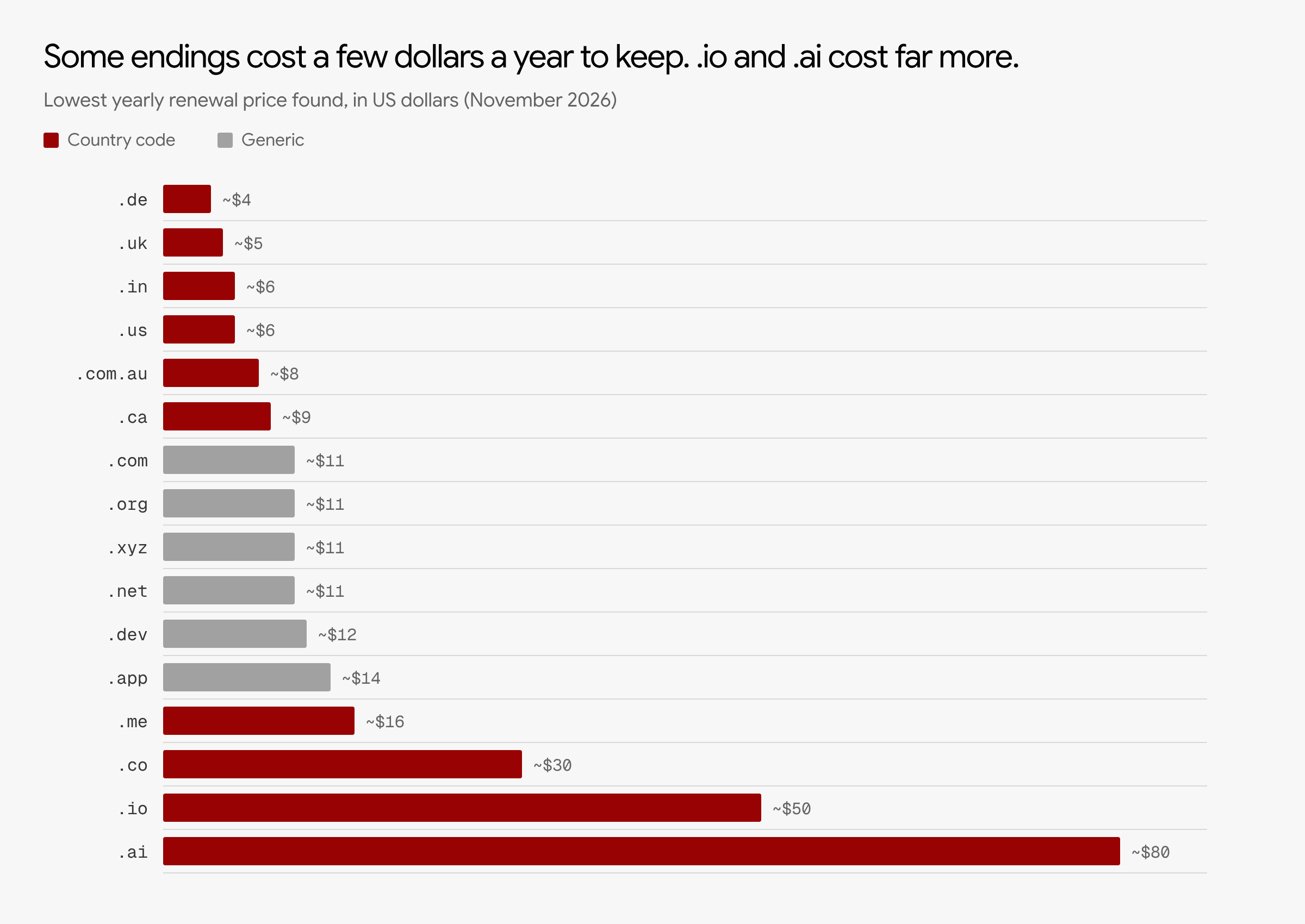
Prices from tldes.com, 6 to 10 Nov 2026
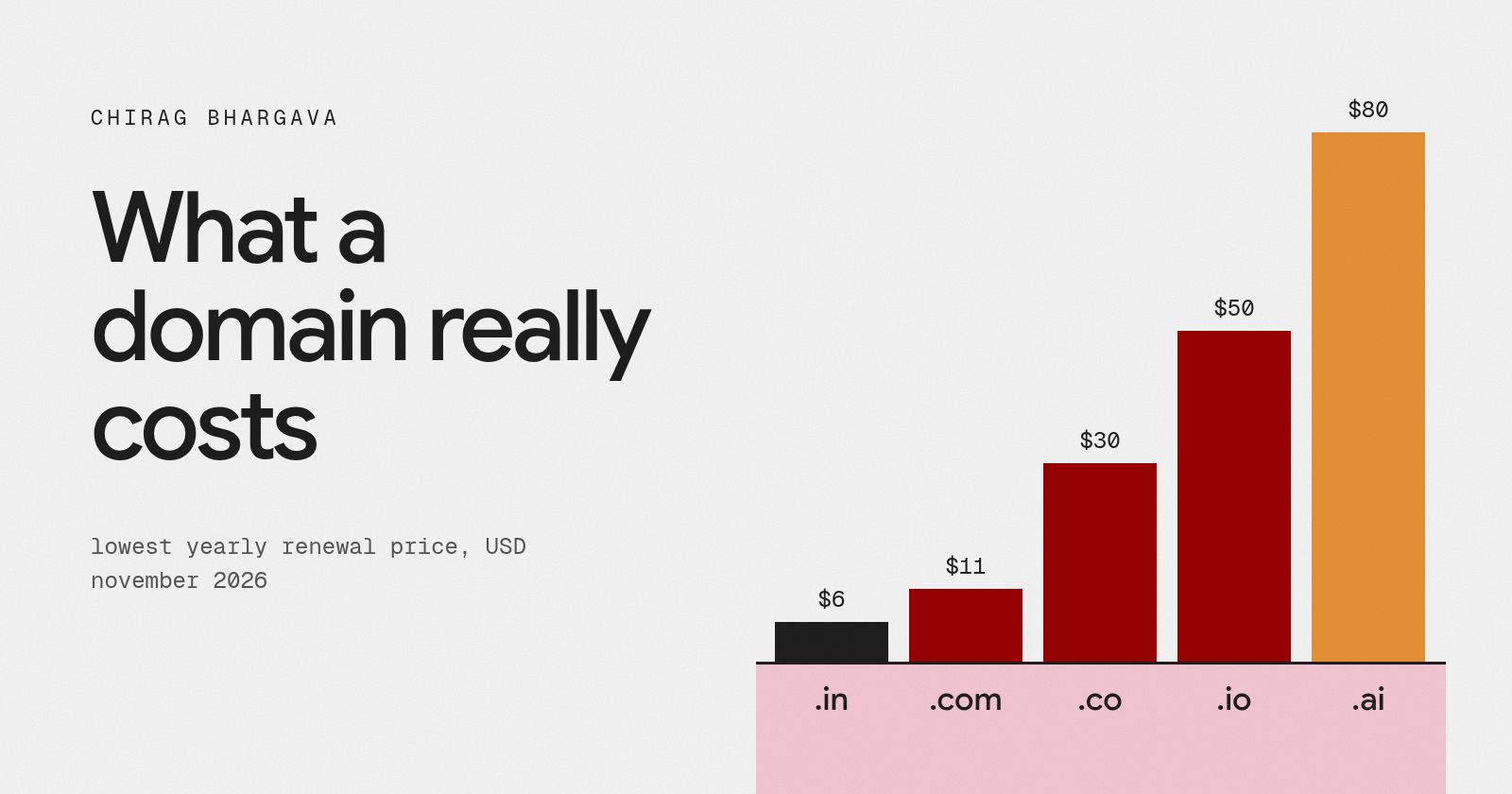
In short: .in, .uk, .de and .us are cheaper to keep than a .com. Most generic endings cost about the same as .com. The trendy startup endings (.co, .io, .ai) cost several times more every year, even when the first year looks cheap.
Which ending fits you
If you are unsure, get the .com. If your customers are mostly in India, a .in works well too, and it costs less to keep.
| Ending | Best for | Who can buy it | Good to know |
|---|---|---|---|
| .com | Almost anything: business, portfolio, product | Anyone | The safest, most trusted choice |
| .in | Businesses and people serving India | Anyone | Cheap to keep; your details can't be hidden behind a privacy service |
| .net / .org | Tech services (.net), non-profits and communities (.org) | Anyone | Good backups if the .com is taken |
| .dev / .app | Developers, apps, side projects | Anyone | Websites on these must use HTTPS (the secure padlock) |
| .xyz | Experiments, short-term projects | Anyone | Very cheap first year, normal price after |
| .uk | Businesses in the UK | Anyone | Cheap to keep |
| .us / .ca / .de / .com.au | Businesses in the US, Canada, Germany or Australia | Locals or local companies only | Not an option without a link to that country |
| .me | Personal sites, "about me" pages | Anyone | Cheap first year, renews higher |
| .co | Startups that can't get the .com | Anyone | Easy to confuse with .com; expensive to keep |
| .io | Tech and developer startups | Anyone | Expensive to keep; long-term future slightly uncertain |
| .ai | AI products | Anyone | The most expensive here, with almost no first-year discount |
Where to buy it
The same domain costs different amounts depending on the website you buy it from (called a registrar). They fall into two camps.
Steady price: about the same every year. Cloudflare, Porkbun, Spaceship and Dynadot. No big first-year bait, no big jump later. Best for anything long term.
Cheap first year, pricey later: GoDaddy, Namecheap and Hostinger. Great opening offers, but renewals can be roughly double what the steady-price sellers charge. Fine for short-term projects.
To give one example, keeping a .com for five years costs about twice as much at GoDaddy as at Cloudflare (Porkbun's calculator).
A few other things worth knowing:
- Indian payments: BigRock and Hostinger bill in rupees and accept UPI, which some people find easier, even if they aren't the cheapest.
- Privacy: most good sellers hide your name and address from public lookup for free. GoDaddy India charges extra for it.
- Cloudflare's catch: it's the cheapest at-cost option, but your domain has to use Cloudflare's own settings service, and free support is limited to a community forum.
GOOD NEWS
- You can move later: if you're stuck with a pricey seller, you can transfer the domain to a cheaper one around renewal time. The transfer usually includes the next year, so you don't pay twice.
Prices tend to go up over time
The company that runs .com raised its price in November 2026 and is allowed to keep raising it a little each year until 2029 (Realtime Register). Every seller passes that on to you.
The good news: when you pay for several years at once, you lock in today's price for that whole period (Openprovider). If you know you'll keep a .com for a long time, paying for a few years upfront at a steady-price seller is a simple way to save.
My simple picks
| Your situation | Ending | Where |
|---|---|---|
| Quick test, hackathon or one-off event (short term) | Whatever name is free; .xyz or .me are cheap to start | Whoever has the best first-year deal |
| Portfolio or personal brand (long term) | .com | Cloudflare or Porkbun |
| Business serving India (long term) | .in, plus the .com so no one else grabs your name | Spaceship or Dynadot; BigRock if you want rupee billing |
| Developer tool or app | .com first; .dev or .app if it's taken | Cloudflare, Porkbun or Dynadot |
| Tech startup set on .io or .ai | Fine, but budget for the yearly cost | Cloudflare or Spaceship |
| Non-profit or community | .org | Cloudflare or Spaceship |
Before you pay, run through this:
- Decide: short term or long term?
- Long term? Check the renewal price, not the first-year price
- Make sure privacy protection is included free
- Turn on auto-renew, so you don't lose the domain by accident
- Turn on two-step login on your account
- Keeping it for years? Consider paying for a few years upfront
Sources
Prices change often, so check at checkout. Pages used for this post:
- Price tracker tldes.com: .com, .net, .org, .xyz, .dev, .app, .in, .io, .ai, .co, .me, .uk, .de, .us, .ca, .com.au
- Porkbun: what a .com costs over five years
- Realtime Register: .com price changes
- Openprovider: the 2026 .com price increase
- Zoho Domains: about .in · Domain India: registering .in · namefi: .in explained
- Openprovider: who can register .ca
- Domain Incite: the future of .io
- Best Hosting India: BigRock review