16 November 2026·9 min readGAME DEVELOPMENT
How I Built a Diwali Game in 14 Hours and It Got 25,000 Visits
How a midnight side project got 25000 visits, and what the numbers taught me.
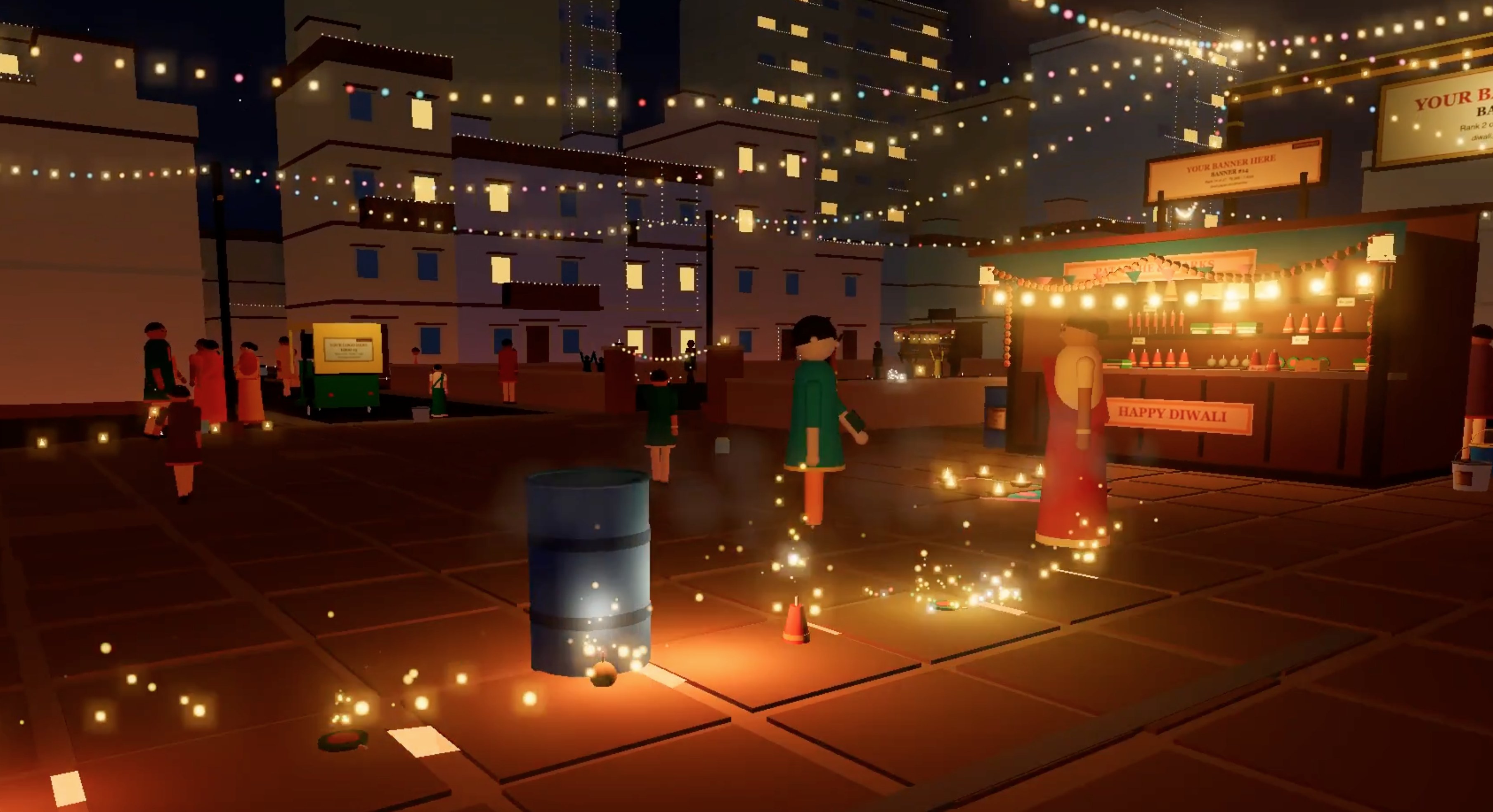
It took 14 hours to build, then nobody touched it for a day. On Diwali night it reached 10,000 visits in about four hours, and it finished with more than 25,000.
This is the story of diwalisimulator.online, a browser game I built for fun two days before Diwali.
The urge
It was midnight, two days before Diwali.
I was at my desk, the way I am most nights. No plan, no deadline for this, nothing I was supposed to be doing. Just a thought that would not leave: what if I built a Diwali game you could play in the browser?
Why? Honestly, because I could. And because it would be cool to watch something I made go viral.
I sat with the idea for a few minutes and played it out in my head. Diwali was almost here. A game like this has a short life. It only matters while people are in the mood to burst crackers. If I was going to do it, it had to be now.
So I made a coffee. I bought a domain. And once the domain was bought, there was no backing out.
I'm a freelance full stack developer. I build websites and products for clients. 3D games were never really my thing. That was exactly why it felt good. It was a break from work, and a chance to see how far I could get with AI on something I had never made before.
Getting the look right
I didn't start with code. I started with how it should look.
I made the assets with GPT, and the first versions looked like what they were: generic AI images. I didn't want that. So I kept going, round after round, adjusting until the lighting felt warm and the objects felt like they belonged on an Indian street on Diwali night.
One rule I set on the first night and never broke: low poly. Simple shapes, light models. I wanted the game to run on as many phones as possible, including the cheap ones.
The first night
When the look was ready, I handed everything to Claude.
Opus 5.5 came back with a working game. Rough, but real. Something I could open, walk around in and play. It was honestly impressive.
While it built, my head kept filling up with ideas. A temple. The kerosene trick that was all over social media. Stacking things on top of a bomb before it goes off. Every idea went onto the list.
I'm on Claude's $20 plan, which gives you usage in five hour windows. That first night ate two of them, and the game still wasn't done.
So I slept for a few hours.
The second day
I woke up with Diwali one day away, and I added something that had nothing to do with fun: ad slots.
My thinking was simple. If this goes viral, brands might pay to be seen inside it. I knew it would take me into the evening, and that the festival was the very next day. I did it anyway. Building the ad slots and getting the game hosted used up a third window.
By now the game had missions, better effects and new physics. And a lot of it was broken.
That's the part nobody warns you about. A game engine gives you physics for free: things fall, bounce and collide the way you expect. In the browser, with Three.js, you get none of that. You write every rule yourself.
My Cursor usage had already run out. Claude needed time to reset. So I brought in Gemini, which I had through my Jio plan, and started sorting the work. Hard problems waited for Claude. Simple ones went to Gemini. My experience building things for clients helped here. I could look at a task and tell how hard it really was, and that is the only reason a $20 plan stretched this far.
The fourth and last Claude window went to one thing: making the game work on phones first. I was sure most people would open it on a phone. Later, the numbers showed I was right. 72% did.
The part I'm proudest of
Before anyone else saw it, I showed it to my family.
All of them played. Not for a minute to be polite. For a long time. Watching them was one of the best parts of the whole thing. It told me the game was actually fun.
Most of my hours had gone into small things most people would never notice, but would feel:
- The chakri spins with a little randomness, the way a real one wobbles.
- The phuljhadi looks real.
- The sutli and the ladi use real sounds, and the ladi has its own animation.
- Walk close to the mandir and you hear the aarti.
- Things catch fire and burn.
- You can aim a rocket at any angle you like.
I believed these details were what would make people share it.
I put the game on Cloudflare and set up analytics to record how people played. The one thing I couldn't finish was taking payments for the ad slots. Legal requirements and a long verification process stood in the way. I let it go.
A quiet night
The night before Diwali, I posted the game on X.
Nothing happened.
I posted again. And again. A few tries, and still almost nothing. So I closed the laptop and went to sleep, and I slept well. I had made something just because I wanted to, and that felt good on its own. It's rare to spend your time on something you actually enjoy, instead of the things you're supposed to do.
Diwali morning
The next morning it was Diwali.
I posted a few more times. Still quiet.
One thought kept coming back: I should have started earlier. If the game had been out a few days before the festival, it would have had time to spread.
By then I'd decided it wasn't worth any more hours. I could spend that time on useful projects or learning something new. So I let it go and got ready to celebrate with my family.
7 PM
At 7 PM, something changed.
A few people had saved the link, and they started visiting. Then X picked up my post.
100 visits. Then 200. And it didn't slow down. It sped up.
I was overwhelmed and happy at the same time. I had built this thing hoping it would go viral, and here it was, actually happening.
I went straight back to my desk. The celebration at home could wait. So could my crackers. I started shipping small fixes to make the game smoother for everyone who was arriving.
About three hours in, the site was getting around 120 views every minute.
Then an email came in. My analytics and visitor counter had stopped. I was on Cloudflare's free plan, and I had hit its limit. I upgraded to the $5 plan right away, but in those 15 minutes I lost around 500 visit counts.
I didn't care. The excitement was bigger than the numbers I missed.
11:04 PM
At 11:04 PM, the counter crossed 10,000 visits.
That's a huge number for me. Only then did I get up from the desk, step outside and burst some crackers.
When I came back in, the number was still climbing.
After the festival
The day after Diwali, people were still playing. Then, slowly, the visits faded.
It made sense. The festival was over, and so was the reason to play. Promoting it on X after that felt pointless.
But by then the game had reached more than 25,000 visits. Even now, it gets around 100 visits a day on its own, and it ranks well on Google.
The numbers
| Metric | All time |
|---|---|
| Total visits | 25,537 |
| Unique visitors | 22,529 |
| Sessions | 26,664 |
| Total play time | 457.4 hours |
| Average session | about 1 min 2 s |
| Peak day | 14,136 visits (8 Nov) |
| Share codes created | 196 |
| Visits from share links | 37 |
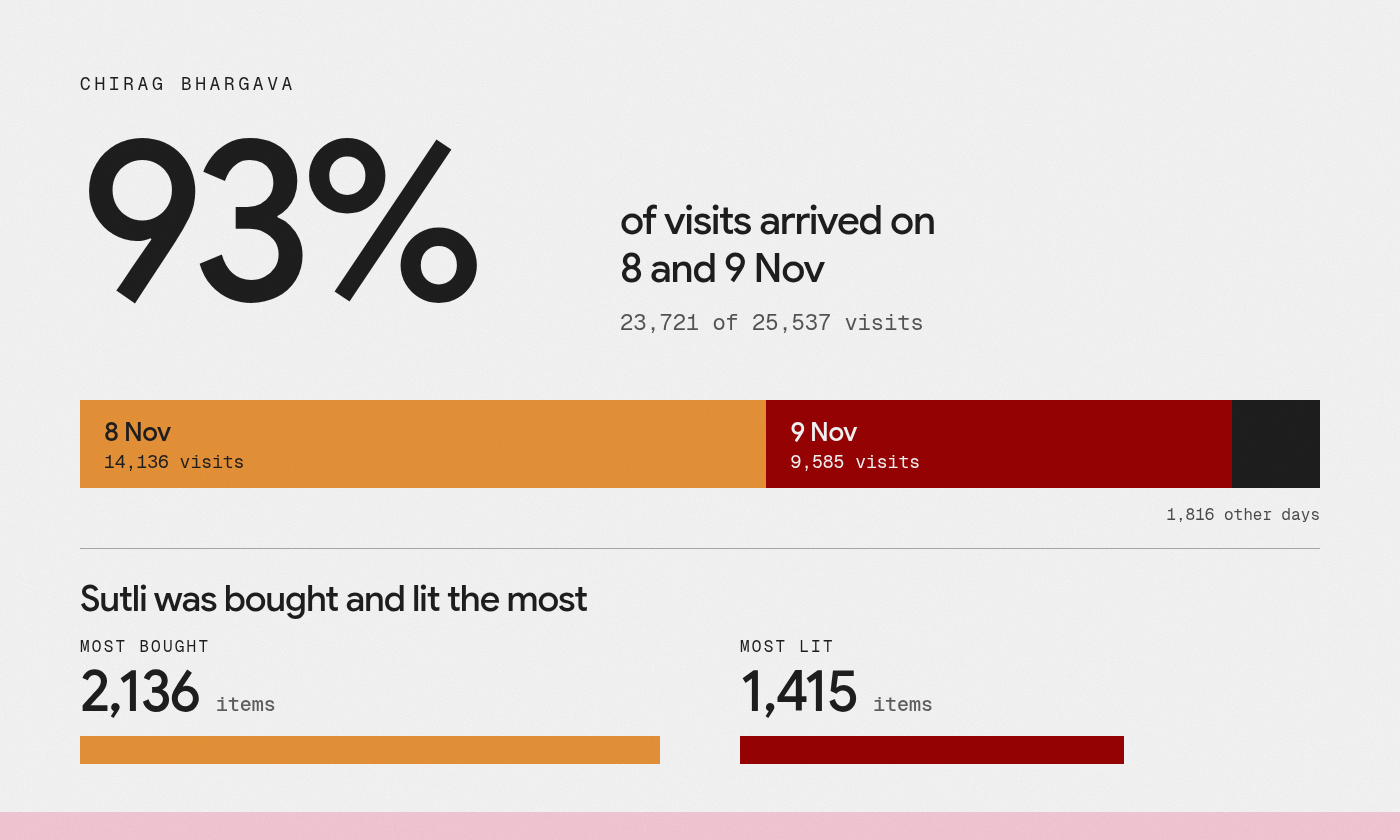
8 and 9 November alone brought 23,721 visits, about 93% of everything. About 88% of visitors came once and never returned. That's what a festival game looks like: one huge night, then a long, quiet tail.
I only started tracking where people came from with an update on 9 November, so these numbers cover 3,865 visits, about 15% of the total:
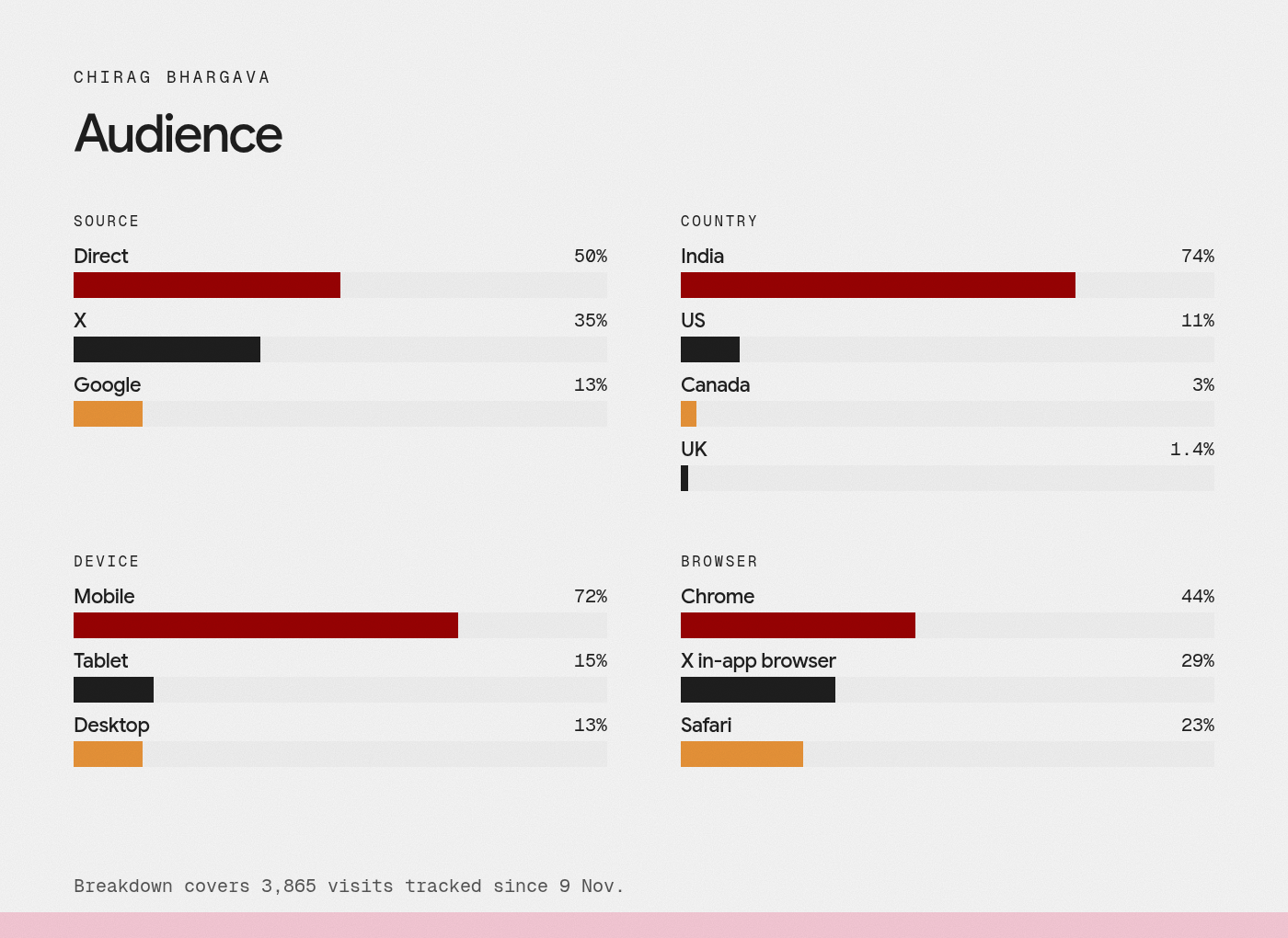
Half came directly, about a third came from X, and Google sent 13%. Three in four were in India, led by Bengaluru, Mumbai, Hyderabad, Chennai and Delhi.
And inside the game, one cracker won. The sutli was the most bought (2,136) and the most lit (1,415), far ahead of the phuljhadi and the rocket.
For AI enthusiasts
A few people asked how much of this was AI. All of it. The whole project was built with AI across 37 sessions, and the main model was Claude Opus 5.5.
Those sessions used about 370 million tokens: around 367 million input, mostly cached context, and around 2 million output. At API rates that works out to roughly $158. I ran it on a subscription, so I never paid per token.
The model wasn't the hard part. Keeping it on track was. Four guardrails did most of the work:
- A rules file. A
CLAUDE.mdfile set the rules for every session. All colours came from one palette file and all lighting from one config. Every model had a poly budget, only primitive shapes were allowed (no imported art), and walking used simple box collision. - Small versions. Each version had a written scope and a "not yet" list, like "no AI neighbours yet". That stopped it from wandering off.
- Tests that enforce the rules. They failed on any raw colour outside the palette and checked every poly budget, alongside the usual game logic tests.
- Screenshots after every change. Playwright scripts captured the game so I could check it visually before shipping.
What it taught me
Timing beats features. All the details mattered, but the game lived on one night. A few days' head start would have changed everything.
Knowing the work stretches a small budget. Sending hard problems to Claude and easy ones to Gemini is how a $20 plan built a 3D game.
Build for the phone. Most people came on mobile, and 29% opened it inside X's own browser.
Next Diwali
The game is on hold for now. I'll pick it up next year, much earlier, so it's already spreading by the time the lamps come out. I'll talk to brands about the ad slots before the rush, not during it.
The goal is 20 lakh visits.
I could have started earlier this year. I don't mind. I built it for fun, and it gave me back more than I expected.
To everyone who played, sent a DM, left a comment, reposted or wrote about the game: thank you. It meant more to me than any number on this page.